It’s hard to believe that it had been nine years since I’ve ventured outside of national borders. I have been so busy exploring the contiguous United States after limited time off while I was working, that I just hadn’t made overseas travel a priority. But when a friend I had not caught up with in a while called to tell me that she’s moved to New Zealand and asked if I’d like to come out for a visit, I immediately said YES! With a travel resume even more extensive than my own, I knew April would make a great tour guide in her new home country of New Zealand. Since I only had a little less than two weeks on the ground, I confined my sightseeing to the landmass of her residence, the northern of the country’s two main islands. Being more of a beach than mountain lover, I was perfectly content to explore the warmer, sub-tropical climate and landscape of the north island versus the colder, more mountainous geography of the southern one.
Although not quite the true antipode location from my home (the west coast of Australia is the spot on the exact opposite side of the earth from North Carolina), it still makes for a long day. I left North Carolina on a Thursday, and after a flight to Houston, and a much longer one to Auckland, I arrived to Aotearoa on a Saturday. Aotearoa (pronounced ah-oh teh-ah ROH-ah) is the Māori word for New Zealand, meaning “long white cloud.” New Zealand is the European name given to these islands by early Dutch explorers, named after Zeeland in the south-west of the Netherlands.
I only went as far south as the western beach town of Piha, but also explored from the eastern tip of the Whangaparaoa Peninsula to the northern terminus of NZ State Highway 1 at Cape Reinga, covering a good bit of the north island. It’s fall season in the southern hemisphere, so the temps ranged from the 50s to 60s with unusually heavy rainfall – 90% of the island’s average rainfall has already fallen in the first 5 months of this year. I’ve been to quite a few places where local residents like to think that their weather is the most erratic by proclaiming “if you don’t like the weather, just wait 5 minutes and it’ll change,” but I’ve never experienced conditions quite as capricious as that of New Zealand. Beautiful sunshiny day one minute, then hurricane force winds and rain in literally the next! A long, skinny landmass, the country provides a minimal obstacle to the convergence of winds from the Tasman Sea to its west and the South Pacific Ocean to its east, to Antarctic weather blowing from its south, or to byproducts of cyclones from its north. Fortunately, our timing was spot on and we always seemed to be just coming in from outdoor adventures when the worse unleashed. We certainly didn’t let the weather impede any of our escapades though 😊
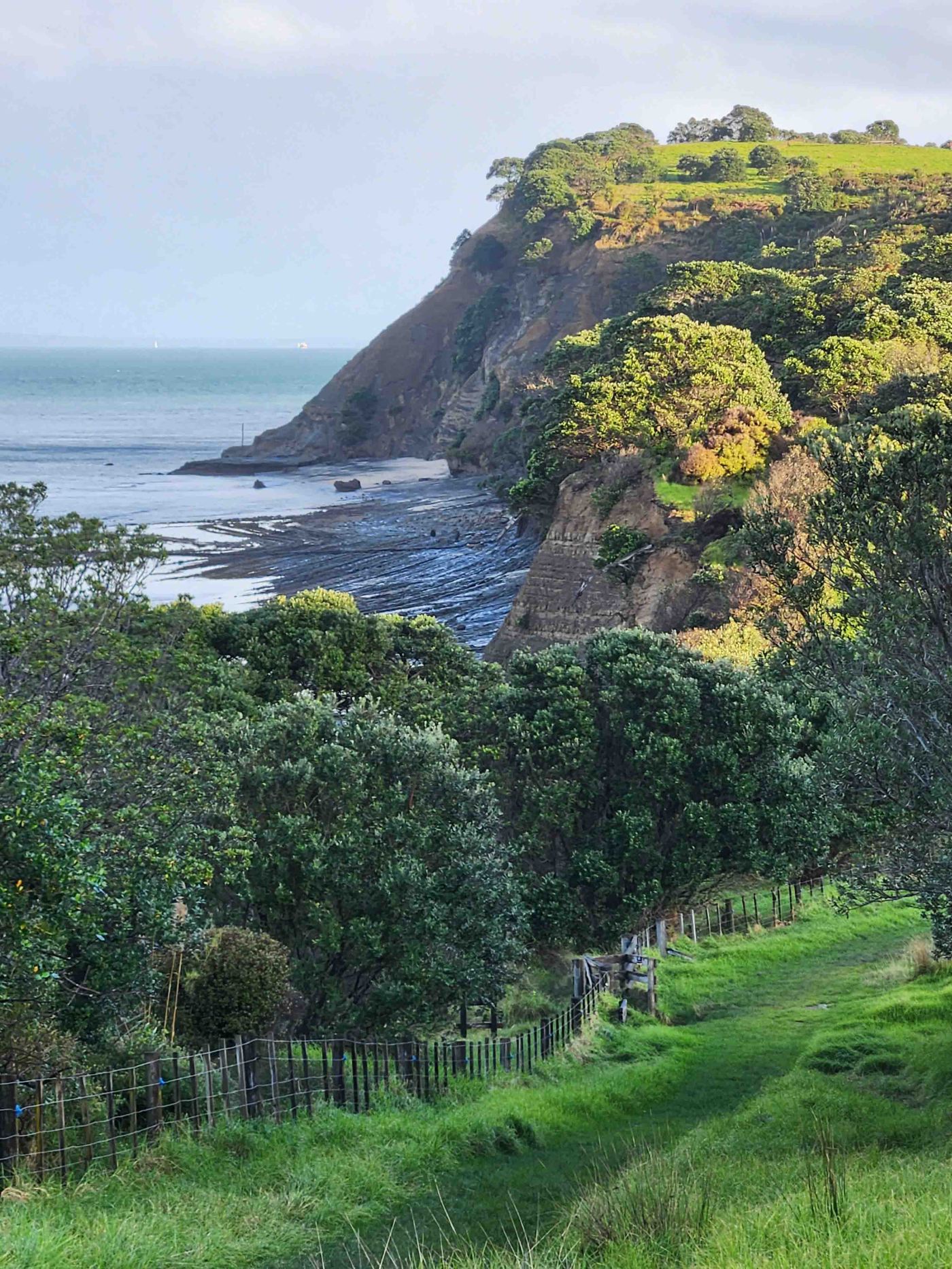
First hike of the trip was in Shakespeare Regional Park on the extreme east side of the island. The scenery was so picturesque that all it needed was a life-sized frame for April, me, and Jitka to pose in!
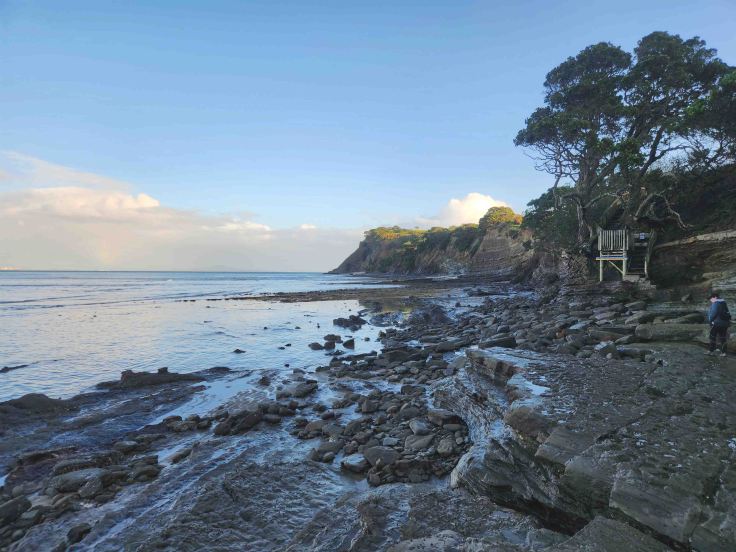
Our wet hike through Shakespeare Regional Park provided breathtaking views of Te Haruhi Bay. The grassy trails in the island’s most visited and accessible open sanctuary highlights the integration of conservation, recreation, and farming.
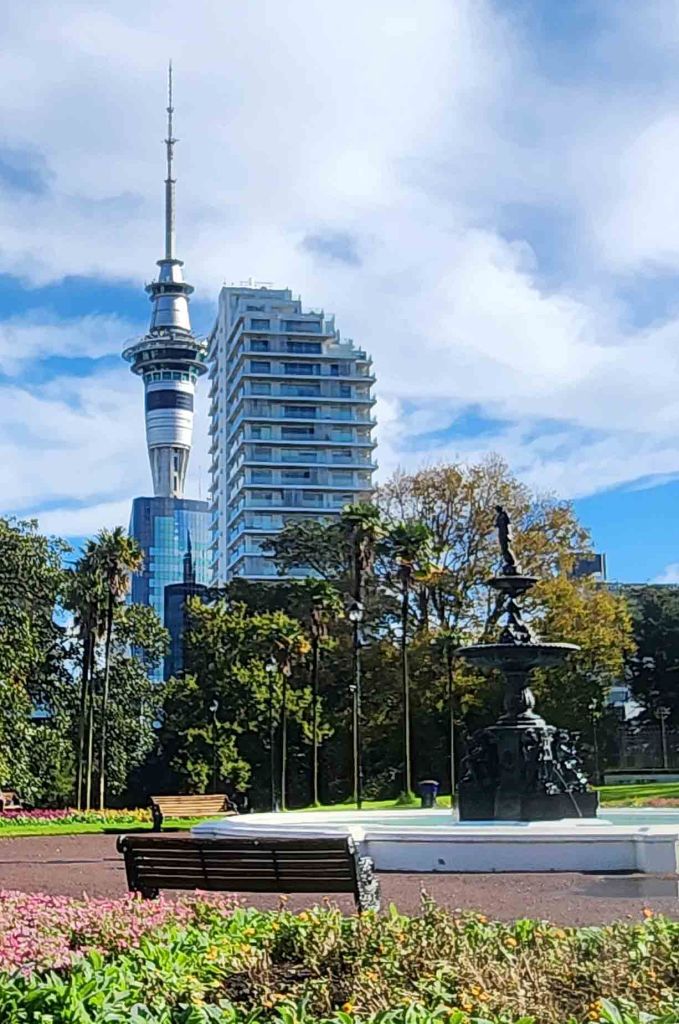
As my hosts worked (hey, not everyone can be retired!), I took the bus into downtown Auckland for a little exploring. Public transportation was safe, clean, and easy and dropped me at Britomart, one of Auckland’s oldest quarters. After a yummy almond croissant and coffee at a café in Viaduct Harbor and an informative tour of the New Zealand Maritime Museum, I made the strenuous hike up the hill (yeah, I got winded!) to Albert Park in the Central Business District.
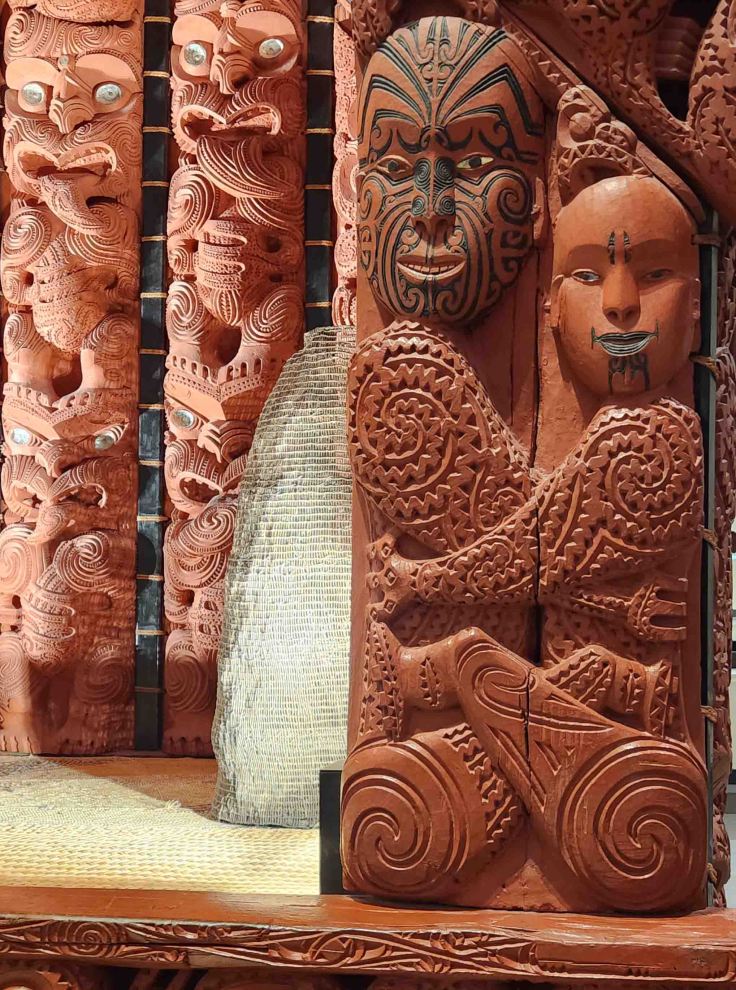
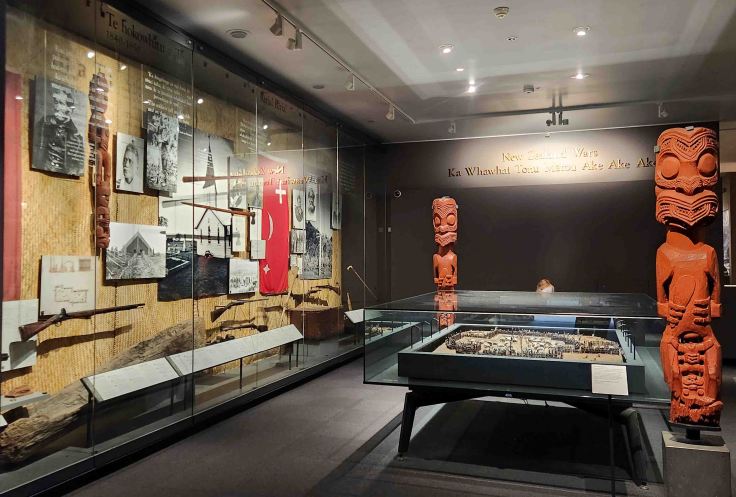
From Albert Park, I strolled through the University of Auckland on my way to the Auckland War Memorial and Museum. The impressive neo-classical three-story building houses exhibits on natural history and the country’s inhabitants, including their involvement in internal and international warfare. Like most societies, the indigenous people of this country, the Māori, have traditions about how the world was created. According to Teara: “In the beginning Ranginui (the sky) [on the left] and Papatūānuku (the earth) [on the right] were joined together, and their children were born between them in darkness. The children decided to separate their parents, to allow light to come into the world. After this, the children became gods of various parts of the natural world.”
The birth of just about every country is marked by internal fighting of its indigenous peoples and warfare with external powers seeking to expand control, and New Zealand is no exception. From intertribal skirmishes, to British and colonizer warfare, to participation in regional and world conflicts, Māori and Pākehā (non-Māori, or white people of colonizer decent) have fought each other as well as side-by-side, throughout their history.
Ika Mata, a Polynesian fish salad made of raw fish, lime, coconut, chili, coriander, sesame, and spring onion, from the museum’s Tuitui Café. One of many delicious, beautifully presented dishes I had during my trip.
My first few days in New Zealand, filled with great company, leisurely physical activity, and cultural education, became an accurate prelude to the remainder of my trip. Next up in part two – road trip to the north!





 FitHippie Adventures
Leave a comment