

For me, one of the most enjoyable aspects of the way I travel is trip planning. When I roll out of my driveway, I have a basic plan in place, especially if I have a hard-time to make, meaning I must be at a certain place on a specific date and time. But the day-to-day aspect of my travels is usually hashed out on the road. Typically, the night before I depart a location, I’ll spend some time perusing maps, weather forecasts, road conditions, and websites and apps that identify scenic routes and unique roadside attractions. My route planning tends to look like a connect-the-dots activity as I attempt to link historical sites, obscure attractions, highly recommended eating establishments, and lodging options with designated byways that will provide great scenery along the way. The most direct route to my destination via interstates is seldom my preferred choice, though I will jump on a short segment of one in order to position myself for better timing or starting point for the day’s itinerary.
On this day of travel, the aim was to get from Tybee Island to Fort Frederica National Monument via scenic backroads through the low country. I was intrigued by the description on America’s Scenic Byways website of Altahama Historic Scenic Byway, so I planned a route that would allow me to ride the 17-mile section of roadway dotted with archaeological sites. It “displays a collage of history; from Guale Indians and 16th and 17th century Spanish missionaries to pre-colonial occupation of Fort King George; from hardy Scottish Highland soldiers and colonists to the rice and cotton planters who succeeded them.” (Am Scenic Byways)
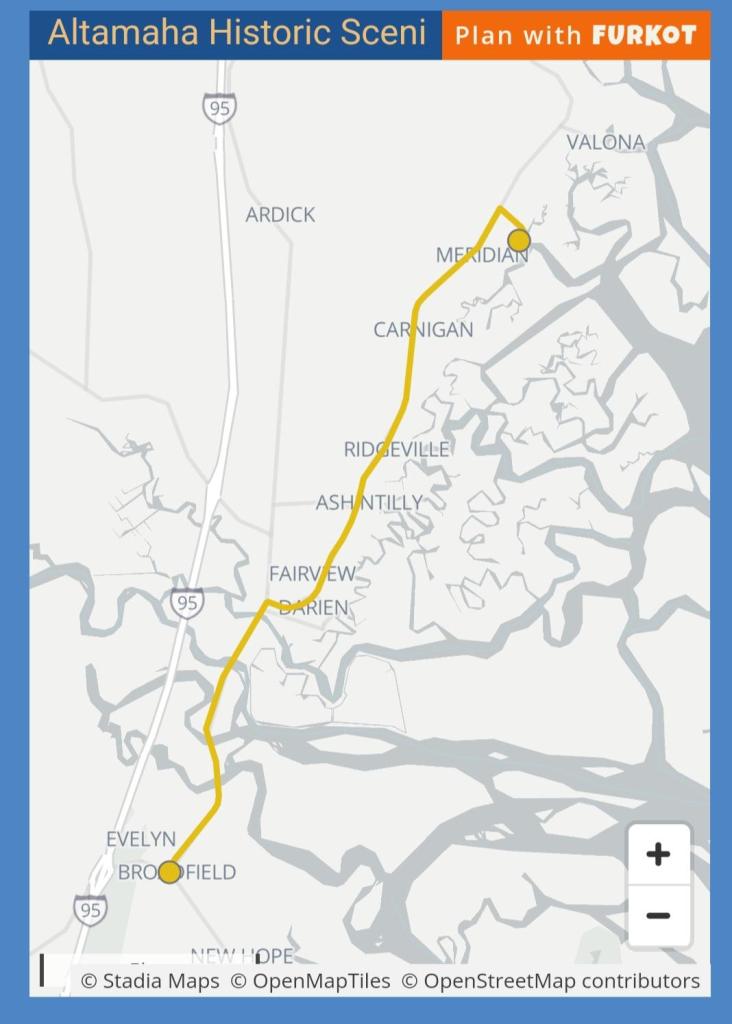
The northern terminus of the route is the Sapelo Island Visitor Center, which was unfortunately closed when I passed through. I didn’t make time to take the ferry to Sapelo Island where a Geechee community still survives, but with the whole island being comprised of National wildlife refuge and management areas, I would definitely like to return and explore the island. The route follows GA-99 until Darien, where it continues via GA-17. “Descendants of the 177 Scottish Highlands who first settled Darien are scattered throughout McIntosh County.” (Am Scenic Byways) “Highland Scots started arriving in the U.S. in the 1730s…and tended to cluster together in self-contained communities.” Large groups established themselves in coastal Georgia and along the Cape Fear River in North Carolina. Based on census data from 1790, it’s estimated that up to 27% of Georgia’s population was Scottish, followed closely by South Carolina (24%), and North Carolina (20%). Their cultural influences can still be felt in towns scattered throughout the Carolinas and Georgia. (Wikipedia)

One of the roadside signs associated with Butler Plantation led me to look up more information about it. Pierce Butler left the plantation to one of his heirs, who was married to a famous actor and abolitionist. Though he kept his wife, Frances “Fanny” Kemble, and their children in Philadelphia, away from the plantation, he allowed her to visit the plantation once for several months. She was so appalled with the condition and treatment of the slaves, that she published her journal from that time, “Journal of a Residence on a Georgia Plantation 1863.” As you can imagine, this publication, in the midst of the Civil War, did not go over well with her husband, and they later divorced. Their daughter, Frances Butler Leigh, aligned with her father’s views on slavery, inherited his plantations after the Civil War and, 20 years after her mother had published her journal, Frances released “Ten Years on a Georgian Plantation since the War” as a rebuttal to her mother’s account. I love when history presents opposing perspectives to an issue, so I’ve added these two books to my reading list!
I continued my rambling through the low country to St. Simons Island for my final sightseeing stop of the day, Fort Frederica National Monument.

According to a NPS brochure, in the 1720s, England bestowed a land grant to James Edward Oglethorpe to establish a colony between the Savannah and Altamaha Rivers. The settlement served a utopian goal of providing a new start for some of England’s “poor people drifting without jobs or languishing in debtor’s jail” as well as providing a military presence against the Spanish. The result was the military garrison of Fort Frederica and its associated town.

After walking as much of the town and fort as my hip would allow, I hopped back on my bike and made my way towards the start of Florida’s A1A Scenic Highway…
 FitHippie Adventures
Leave a comment