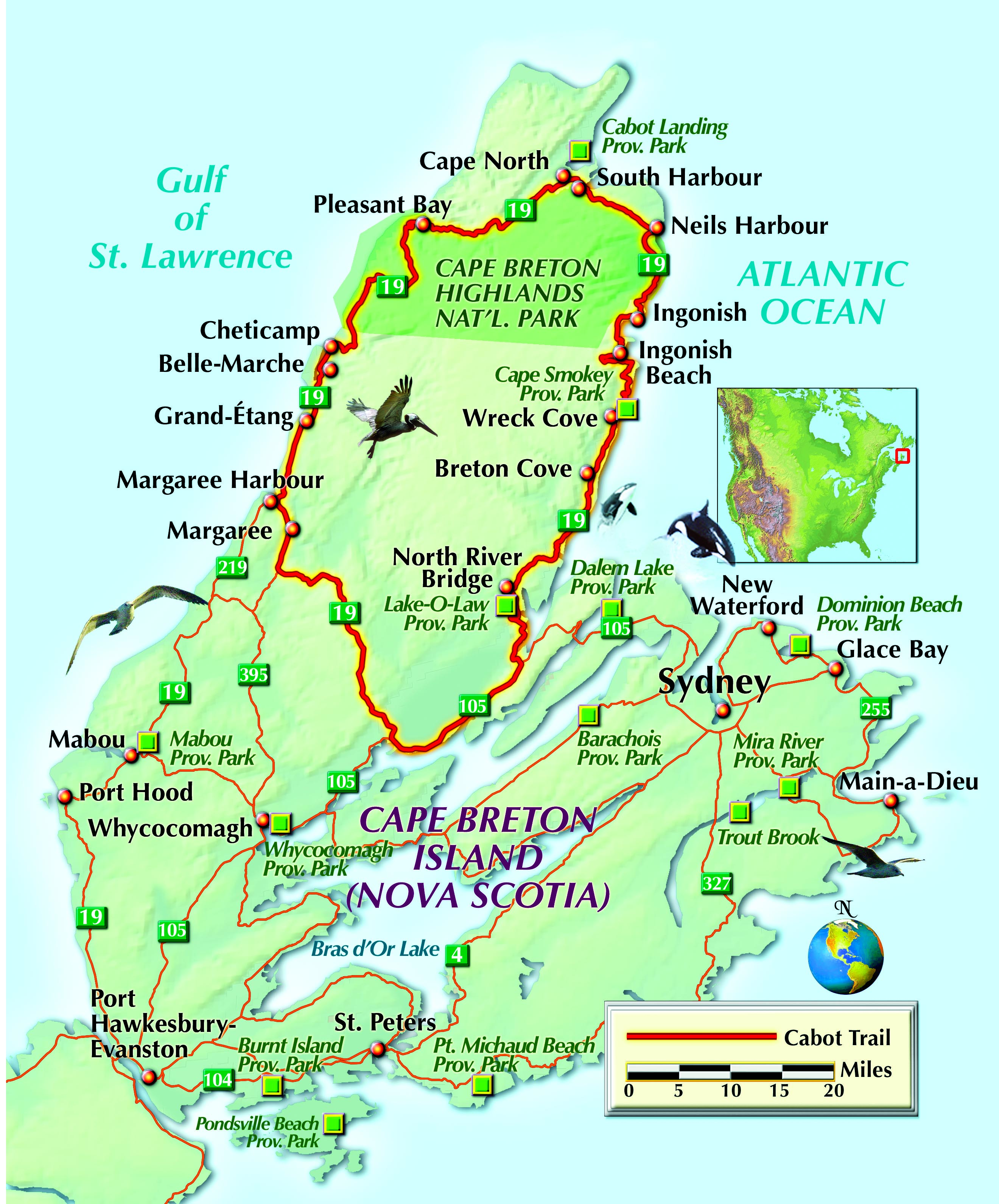
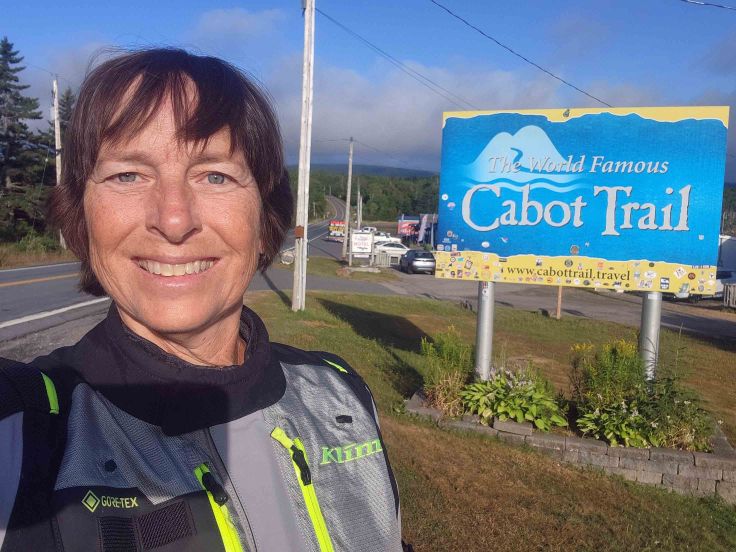
I need more time to dig into genealogy before I can post Part 3 of my heritage trail ride, so in the meantime, I’ll share highlights from a legendary route I rode – the Cabot Trail! This roughly 180-mile loop circumnavigating the northern part of Cape Breton Island, Nova Scotia, is a ride that is on just about every biker’s bucket list; if it’s not, it should be! Packed full of long sweepers, sprinkled with some legit twisties, this route takes you through spectacular coastal views, quaint fishing villages, forested highlands, as well as Acadian and Gaelic history.
The 180-mile Cabot Trail runs right through Cape Breton Highlands National Park. Unfortunately, all hiking trails were closed while I was there (Aug 2025) due to extreme fire risk from an extended drought, so I didn’t get to hike the legendary trails in the park, but there was still spectacular scenery to ride through.
I homebased out of the Silver Dart Lodge in Baddeck for several days. Just a couple of miles off the Cabot Trail, and centrally located on Cape Breton Island, it was the perfect place from which to explore both the west and east sides of the island. Named after the first powered, heavier-than-air (i.e., non-balloon) machine to fly in Canada, it offered great views, quiet and comfortable accommodations, and local seafood dinners. Also staying at the hotel was a busload of tourists out of Halifax. They were fascinated with a woman biker traveling alone, but none more so than their intrepid bus driver Kevin. Being an early riser like me, Kevin and I would chat in the lodge parking lot over coffee in the morning before taking off for the day.
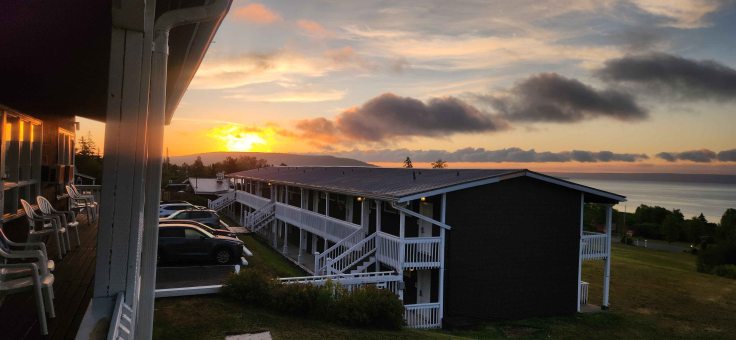
The back porch of my room at the Silver Dart Lodge overlooked Bras d’Or Lake and provided a great backdrop to this gorgeous sunrise.
A professional motor coach driver for 30+ years, Kevin also served as a police officer and mentor to numerous youths over the years. He drove his passengers counterclockwise on the Cabot Trail the same day I rode it clockwise. When I crested a steep incline on the north side of the island, I spotted their oncoming bus and was greeted with the windows full of smiling, waving passengers when they recognized me!
I was advised by other bikers I had met in Canada to ride the Cabot Trail counterclockwise to avoid having to cross traffic at scenic lookouts, even though the best “first view” of the North Atlantic is experienced on a clockwise ride. I just made sure to stop and look in both directions often!
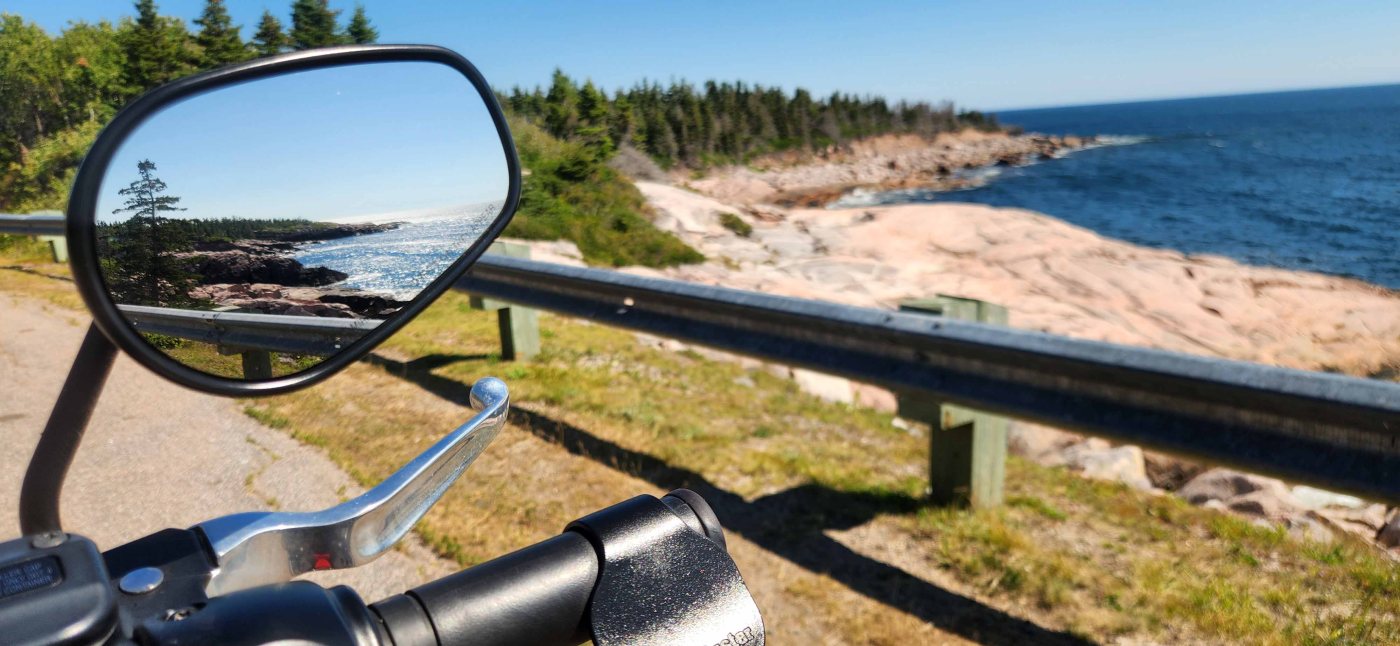
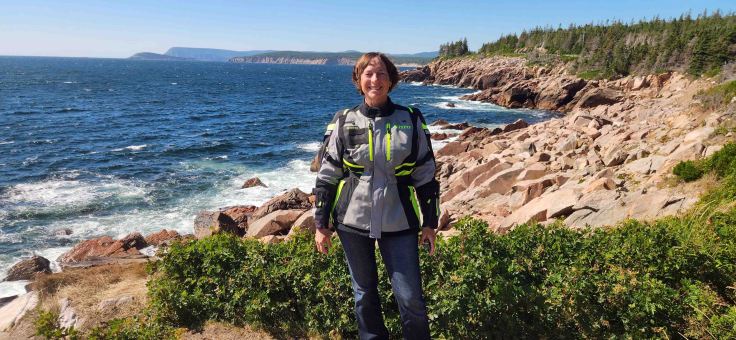
I stopped off at Pathend Brook Lookout for this breathtaking view just north of Wreck Cove. The pullouts along the Cabot Trail are large with great pavement, making it easy to stop and take in the sights.
I asked the park ranger at the Ingonish Visitor Centre for a good coffee recommendation along the Cabot Trail, and she recommended Salty Rose’s and the Periwinkle Café. Part café, part inn, part arts and crafts gallery, this little stop did not disappoint.
A little farther up the east coast, I stopped off at Lakie’s Head, a great overlook for spotting sea birds and whales. Lots of birds, but no whales on this day.
On the strong recommendation of lunch at The Chowder House, I rode north towards the small, picturesque fishing village of Neil’s Harbor. Unfortunately, I was too early for lunch (oh, the challenges of being a morning person!), but the area lived up to its charming reputation.
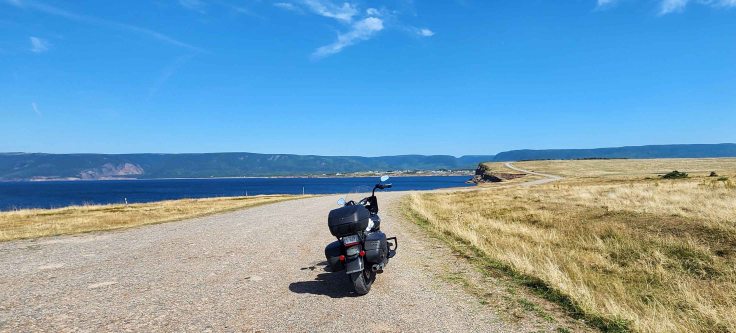
Another great pulloff for whale watching, this one on the western side of Cape Breton Island facing the Gulf of St. Lawrence is MacKenzie Mountain Lookoff. I didn’t see any whales, but I got a great view of the Cabot Trail roadway appearing like a ribbon along the coast.
The fishing community of Chéticamp on the western shore of Cape Breton Island was founded in 1785 by Acadians escaping British rule on the Nova Scotia peninsula. I had read that the Chéticamp lighthouse was painted in the traditional Acadian colors of blue, white, red, and gold, but after riding 4 miles of gravel road (one-way) to get to it, I was disappointed to discover a small, non-descript lighthouse with peeling white paint.
I spent the next day after riding the Cabot Trail exploring Baddeck. Situated near where the Baddeck River empties into Bras d’Or Lake, this little village of less than 1,000 residents is full of character and history. First occupied by the Mi’kmaq people, Celtic people from Ireland and Scotland, known as Scottish Gaels, settled in the area in the late 18th and early 19th centuries. Now mostly sustained by tourism, Baddeck was once a shipping center for surrounding mining, trapping, fishing, forestry, and farming activities. It is also the town Alexander Graham Bell and his family called home, and where he and his team successfully conducted the first flight of a motorized heavier-than-air aircraft in 1909 called the Silver Dart. Constructed of steel tube, bamboo, friction tape, wire and wood, the wings were covered with rubberized, silvery balloon cloth (thus the name). (Wikipedia)
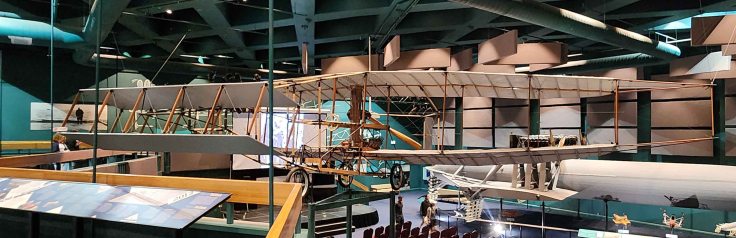
A full-size replica of the Silver Dart hangs from the ceiling of the Alexander Graham Bell National Historic Site in Baddeck. Though best known for his invention of the telephone, the native of Edinburgh, Scotland held patents for telegraphs, photophones, aerial vehicles, and hydro-planes, as well as founding the National Geographic Society in 1888. (Natl Inventors Hall of Fame)
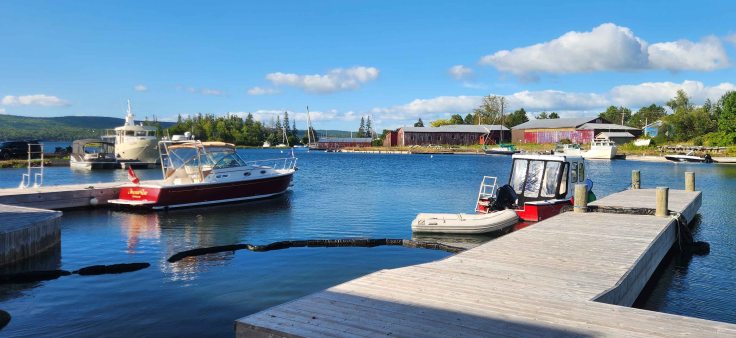
A relaxing stroll along Baddeck Harbor took me past lots of tranquil coastal scenes like this one.
I thoroughly enjoyed my days touring the north-western side of Cape Breton Island. Though I wasn’t able to explore the Highlands National Park trails like I wanted to, the spectacular riding and sightseeing provided by the Cabot Trail certainly helped make up for it. There was so much to see and do in this area, I will definitely be back!





 FitHippie Adventures
Leave a comment