Cutting a 75-mile wide, 180-mile long path, extending from Gettysburg, PA to Monticello, VA, the Journey Through Hallowed Ground National Heritage Area covers “400 years of multicultural American heritage.” According to the National Parks Conservation Association, this swath of land includes hundreds of African-American and Native-American Heritage Sites as well as battlefields and historic sites from the Revolutionary War, French and Indian War, the War of 1812, and the largest collection of Civil War sites in the nation. The homes of nine U.S. Presidents are also scattered amongst the trail comprised of 13 National Park units, two World Heritage sites, 16 National Historic Landmarks and over one million acres on the National Register of Historic Places.
In 2009, the main roads running through this area, Route 15/20, was designated as the Journey Through Hallowed Ground Scenic Byway. The route roughly follows what was “an active transportation route during the Revolutionary War, a critical transition zone for the Underground Railroad, and a key battleground during the Civil War. This early corridor was the literal roadbed for the creation of our country and American ideals.” With only a few days to explore this iconic route, I focused on sites associated with the Civil War and African-American liberation.
Since I had spent several days exploring Gettysburg National Military Park in 2014, I decided to confine my tour to a few sites in Maryland and started with Catoctin Mountain Park, about 20 miles south of Gettysburg. This area of the Blue Ridge Mountains is so peaceful and beautiful, that a camp was built in the area in 1942 to serve as a retreat for federal employees’ families, including President Roosevelt. In 1952, the area where the camp was located was split into Catoctin Mountain Park (managed by the NPS) and Cunningham Falls State Park, with the now strictly Presidential Retreat (renamed to Camp David two years later after President Eisenhower’s grandson) remaining within the confines of Catoctin Mountain Park, but not accessible to the public. The trail in this photo (Wolf Rock) was one of the numerous tranquil trails in Catoctin Mountain Park.
The whole area is simply stunning, so instead of getting back on the multi-lane, super busy federal highway designated as the primary route for the Journey Through Hallowed Ground Scenic Byway (US-15), I jumped onto scenic state roads to ride through Cunningham Falls State Park, Frederick Municipal Forest, and Gambrill State Park on my way to Monocacy National Battlefield. This pic is of Hunting Creek Lake in Cunningham Falls State Park.
“During the summer of 1864, the Confederacy carried out a bold plan to turn the tide of the Civil War in their favor. They planned to capture Washington, DC and influence the election of 1864. On July 9, however, Federal soldiers outnumbered three to one, fought gallantly along the banks of the Monocacy River in an effort to buy time for Union reinforcement to arrive in Washington, DC… While the Confederates had won the Battle of Monocacy, Lew Wallace [Union] was ultimately successful. His efforts had delayed Jubal Early’s [Confederate] advance long enough for additional Union reinforcements to reach Washington D.C [and thwart their Capital takeover].” NPS website
By the time I finished watching the NPS film about the Battle at Monocacy and then touring the site, it was late afternoon and I still hadn’t figured out where I was going to spend the night. I knew I wanted to be in Sharpsburg, MD (about 40 minutes away) in the morning so I could get an early start on touring Antietam National Battlefield. So, I did a quick Google search for lodging near Antietam Battlefield, and the first thing that popped up was The Inn at Antietam, a charming B&B in an 1883 house. I figured there was no way there would be an opening during tourist season, but sure enough, there was one room available! What a great find! It was so close to the National Battlefield that my bedroom overlooked the battle cemetery!
“Approximately 4,000 people were killed, and in the days that followed, many more died of wounds or disease. The peaceful village of Sharpsburg turned into a huge hospital and burial ground extending for miles in all directions. Burial details performed their grisly task with speed, but not great care. Graves ranged from single burials to long, shallow trenches accommodating hundreds [many had been buried in shallow graves in nearby fields].” In 1865, Maryland established this burial site and Union soldiers were painstakingly identified and finally interred here. NPS website
Not only did the Inn at Antietam proprietors, Miriam and Will, provide a cozy, historic setting in which to recharge and meet other folks, they provided a tasty, homemade breakfast to get the day started. I entered the communal area to the smell of exotic spices coming from the kitchen, which turned out to be the main dish of the multicourse breakfast they had planned for their guests: shakshuka, a North African and Middle Eastern meal of poached eggs with tomato sauce and spices. The rest of the meal included bacon, homemade bread, fruit bowls, rhubarb strawberry bars, chocolate banana muffins, and berry semifreddoes! Even though I ate my muffin with breakfast, they packed an extra one up for me to take on the road 😊. I will definitely stay here again!
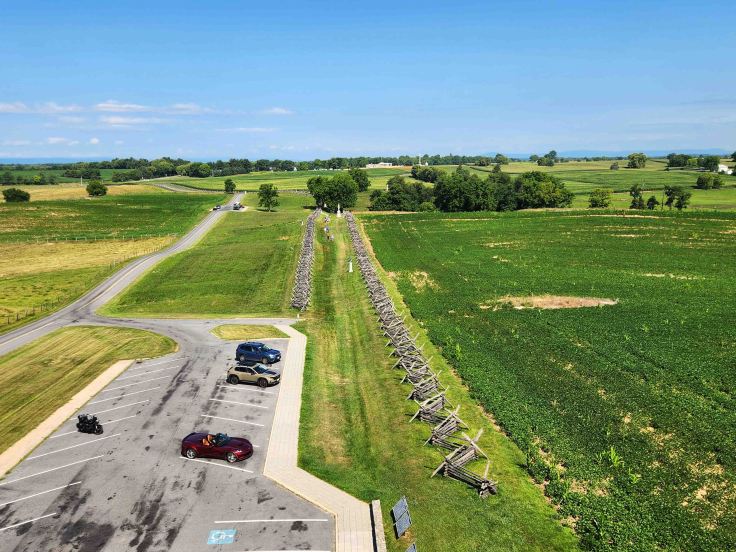
From this view of the Antietam National Battlefield taken atop an observation tower, off in the distance you can see the Miller farmhouse and the infamous cornfield where most of the bloody battle occurred. The film at the Visitor Center really helped to set the stage for a meaningful tour of the battlefield, making this birds’ eye view even more relevant. Visiting Dunker Church and Burnside Bridge also provided great perspective of how that fateful day played out.
“The Appalachian Trail is a 2,190+ mile long public footpath that traverses the scenic, wooded, pastoral, wild, and culturally resonant lands of the Appalachian Mountains. Conceived in 1921, built by private citizens, and completed in 1937, today the trail is managed by the National Park Service, US Forest Service, Appalachian Trail Conservancy, numerous state agencies and thousands of volunteers.” NPS website
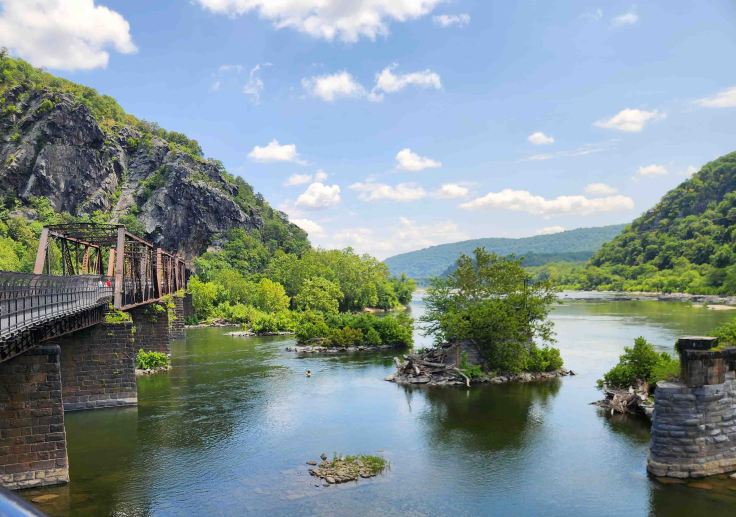
“Preserving America’s early transportation history, the C&O Canal began as a dream of passage to Western wealth. Operating for nearly 100 years the canal was a lifeline for communities along the Potomac River as coal, lumber, and agricultural products floated down the waterway to market. Today it endures as a pathway for discovering historical, natural, and recreational treasures.” The 74 locks (Lock #33 in photo) along the canal (which runs alongside the Rivers) were used to raise and lower boats. The 184.5-mile trail, extending the length of the canal, was used by mules to pull boats. NPS website
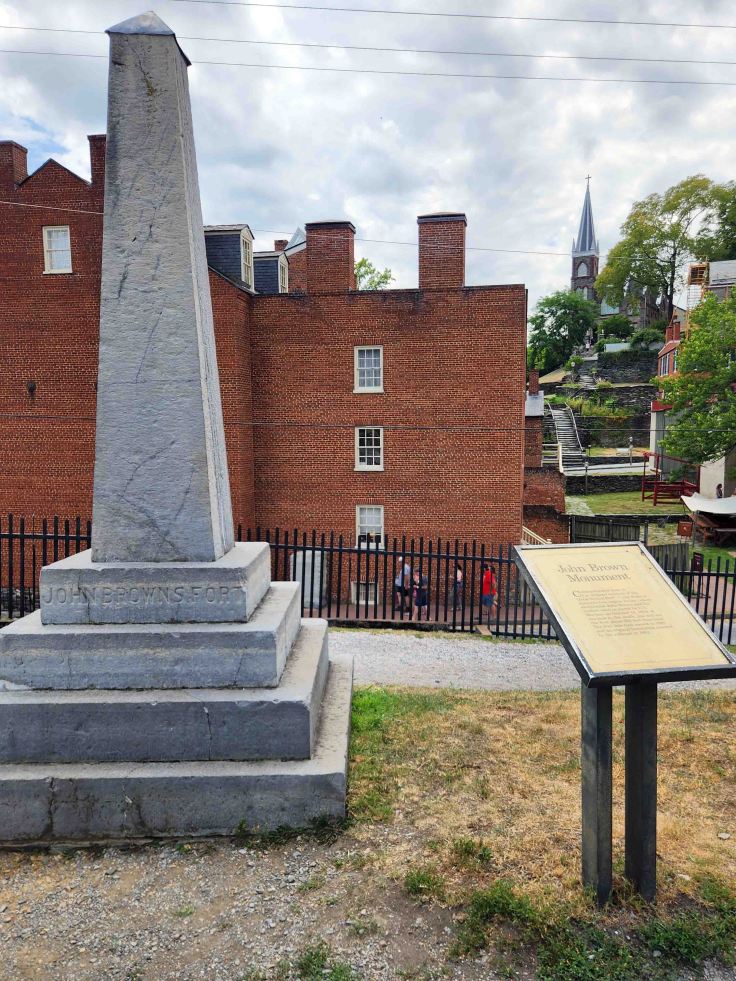
As home to the National Armory and Arsenal, Harpers Ferry presented a prime target to abolitionists and Confederate troops alike. In 1859, the staunch anti-slavery advocate John Brown, and a handful of supporters, raided the Armory in hopes of arming slaves and revolting against slave-holders. After 3 days of occupying the Armory, the revolt was put down, Brown was arrested, then later tried, convicted, and hanged for his role in the uprising. Though the raid was a failure, the event is credited as a catalyst for the Civil War. Later, in 1861, Confederate forces confiscated the Armory’s ordnance and supplies, then returned in 1862 as part of the Maryland Campaign. NPS website
After taking in as much history as my brain could hold in one day, I made my way to Charlottesville, VA for the night, then headed down to Hardy, VA in the morning to visit the Booker T. Washington National Monument. Born to an enslaved woman on a 200+ acre farm (in a cabin similar to the replica in this pic), Booker T. Washington may have started his life in slavery, but with great tenacity, rose to become the first principal of Tuskegee Normal and Industrial School (the predecessor to the Tuskegee Institute), a sought-after advisor, author, and orator, and ultimately, one of the most influential African Americans of his era. NPS website
My short excursion along the Journey Though Hallowed Ground National Heritage Area and Byway served as an introduction to what I hope will be future return trips to the area. With hundreds of historic and scenic sites, this heritage area and byway require many more days and miles to explore. It truly is “where America happened.”
I can’t imagine the awful job of digging up, identifying and re-burying thousands of bodies in these old battlegrounds. That must have been the genesis of “bad duty”.
It was pretty sobering to read resident accounts of how aweful the sights and smells were for a very long time after the battle (months). I’m learning so much…good and bad!







 FitHippie Adventures
I can’t imagine the awful job of digging up, identifying and re-burying thousands of bodies in these old battlegrounds. That must have been the genesis of “bad duty”.
You are living my dream!
Chief
LikeLike
It was pretty sobering to read resident accounts of how aweful the sights and smells were for a very long time after the battle (months). I’m learning so much…good and bad!
LikeLike