Terrebonne is part of the traditional 22 parish Cajun homeland of Acadiana, in what is considered French Louisiana. Covering a little over 14,000 square miles, Acadiana spans from just west of New Orleans (no, the city is not part of Cajun country!) all the way to the border of Texas along the Gulf of Mexico. Even though I rode west from Bayou Blue and Houma, I was still in Acadiana for quite some time.
I hadn’t been to Avery Island and the Tabasco grounds for quite some time, so I decided to swing through there for lunch. It’s hard to believe, but Tabasco sauce is made from only three ingredients: peppers, salt, and vinegar. The founder of Tabasco sauce, Edmund McIlhenny, started his commercial hot pepper sauce business in 1865 with seeds given to him from Mexico or Central America. Though the original crops of peppers were grown on Avery Island in Louisiana, the high demand for the iconic sauce (there were 11 different ones onsite to taste) outgrew the island. Now, 98% of the peppers used to make the various sauces are grown in Central and South America, as well as South Africa, but they are still mashed and packed with salt the same day they are picked, and shipped back to Avery Island for aging. (Taste of the South Magazine) According to information placards at the factory, the mash is stored for up to three years in oak barrels with high-quality distilled vinegar, and salt from the Avery Island salt dome.
Always thankful when I found a miniature bottle of Tabasco hot sauce in my MRE (Meals Ready to Eat) while in the military, I didn’t realize that the company had such a long connection with the Armed Forces. According to an exhibit in the museum on the grounds, ancestors of the McIlhenny family served in the Spanish American War and World War II. The tiny bottles started showing up with military rations during Korea and Vietnam, then became an official part of MREs in the 1980s. Veterans receive a service-specific MRE bottle of Tabasco when they take a tour, so I got three – one for each branch in which I served!
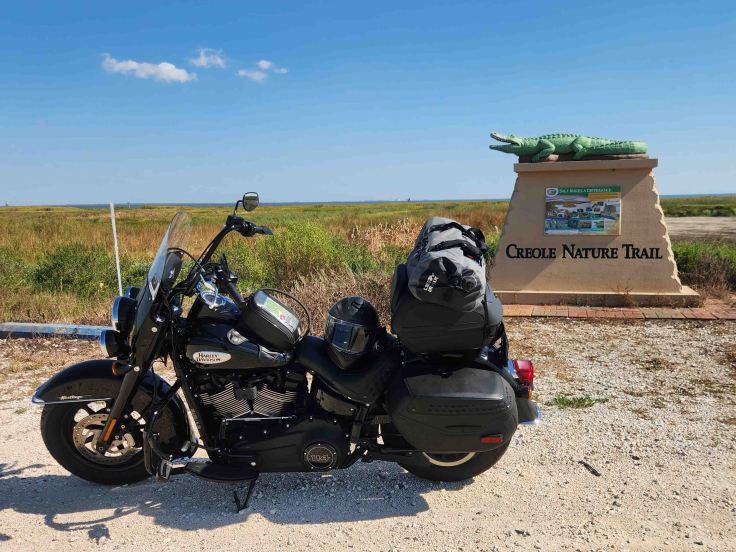
From Avery Island, I jumped onto the 180-mile Creole Nature Trail, a National All-American Road, which “meanders through marshes and prairies along the Gulf of Mexico.” I enjoyed sightseeing throughout Rockefeller Wildlife Refuge, which is also an outdoor laboratory for collaborative research on marsh management and wildlife and fisheries resources.
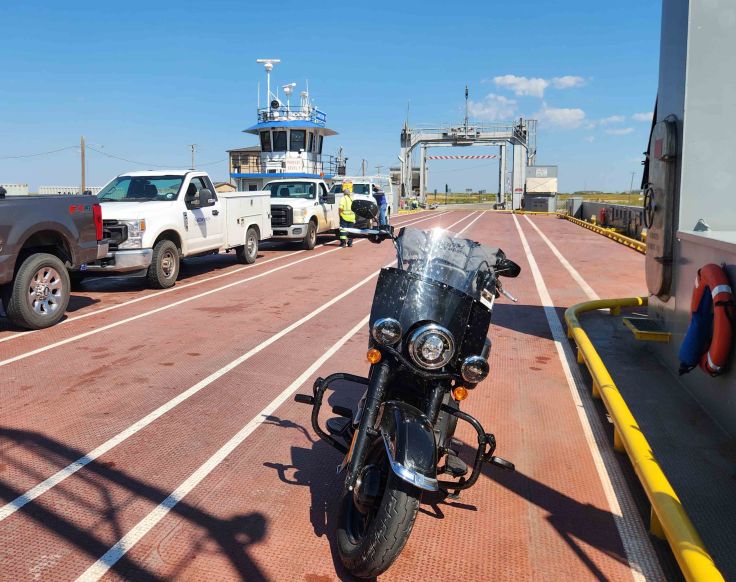
I love traveling by boat, so I transitioned from the refuge in Cameron to Holly Beach via the ferry.
You see all those bug guts on the front of my bike on the ferry? Those are from Plecia nearctica, aka Lovebugs! (Wikipedia) This pic is from a post in my mom’s yard. A species of marsh fly found along the Gulf Coast, these “honeymoon” bugs join tail-to-tail twice a year for mating season, hovering in the air and drifting slowly. . . right into windshields and vehicle grills. They are attracted to heat, consequently, they are so plentiful in the air over Louisiana asphalt that it sounds like rain hitting the windshield as you roll down the highway. If not washed off quickly, their acidic remains will eat paint and etch chrome within a couple of days. Yes, I was as covered in them as my bike.
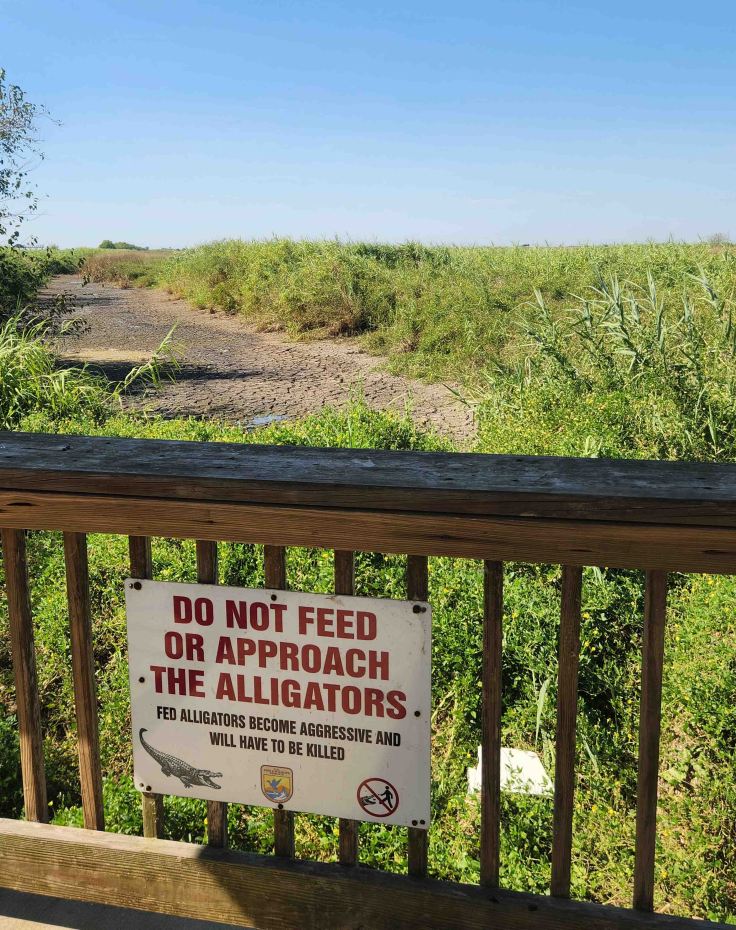
Just north of Holly Beach in Hackberry, I pulled off at a scenic overlook in Sabine National Wildlife Refuge. It had been so dry in south Louisiana this year, that even the marsh was dried up, making an alligator sighting here very unlikely.
Other than a fresh roadkill, this was the only alligator I saw on the south Louisiana scenic byway. This marsh is where inland fresh water and salt water from the Gulf of Mexico mix. That patch of dirt to the right of the sign should be covered in brackish water, but the lack of rainfall this year is wreaking havoc on the delicate chemistry of Louisiana’s wetlands.
Creole Nature Trail Adventure Point in Sulphur, Louisiana has great exhibits on wildlife that can be seen along the trail, as well as very informative, interactive displays on Cajun food, music, and culture in general. The display of a kitchen with Louisiana products and staples smelled like my momma’s house on Sunday at dinner (aka Cajun lunch) time 😊
There are so many definitions and interpretations of the difference between things that are “Cajun” and “Creole,” I was fascinated with this succinct delineation of Cajun and Zydeco music at the Creole Nature Trail Adventure PointVisitor Center.
South Louisiana is home to several oil refineries, gas plants, and other facilities related to the oil and gas industry. According to Energy Information Administration, “Louisiana’s 15 oil refineries account for 1/6 of the nation’s refining capacity.” The state also “accounts for 10% of total marketed natural gas production and holds about 7% of the nation’s natural gas reserves.” For better or worse, Louisiana fuels the country and just about every family in Acadiana has ties to the industry. This pic was taken from my hotel room in Sulphur, Louisiana.





 FitHippie Adventures
Still living the dream, Darlin’. Keep the history coming.
Chief
LikeLiked by 2 people
Thank you, lots more to come 😀
LikeLike