

In my fifties, and with no requirement to learn Spanish for a job or specific volunteer opportunity, why am I doing this? I get asked that a lot, from people both here and back in the States. It seems that most folks learn a second language for a particular reason. For me, it’s for multiple reasons.
Brain Health
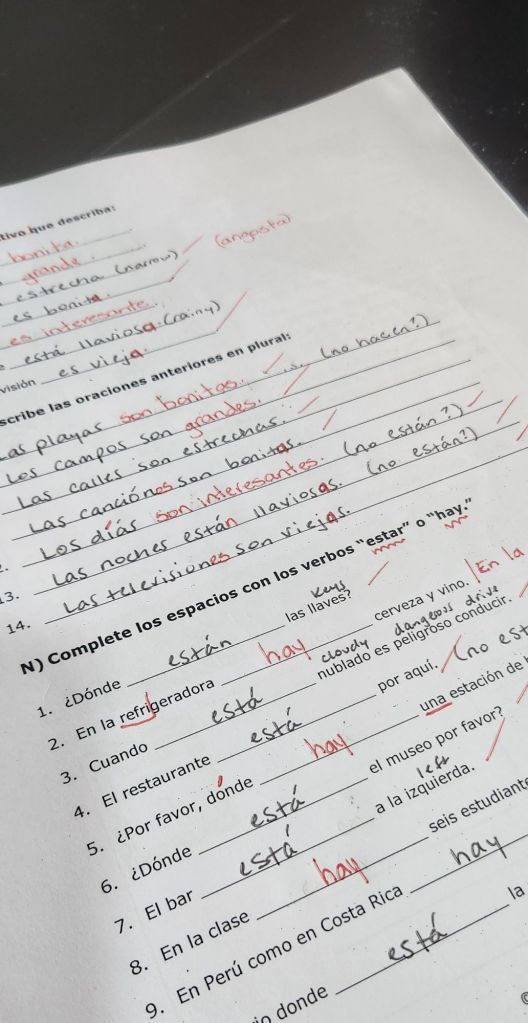
Now that I don’t have to stay current for a profession, I want to make sure that I keep my brain active as I age. There are many benefits to a bilingual brain. People who speak more than one language have been shown to have delayed onset of cognitive decline, improved memory and task-switching ability, and increases in size of both white and gray matter in the brain. (U of Potomac).
Learning Spanish as a second language to English challenges the brain in so many ways. Though the two languages use the same alphabet (with a couple of exceptions), just about every letter represents a different sound within each language. In Spanish, the letter V sounds like a B, the letter E sounds like a long A, the letter H is completely silent, the letter J sounds like an H, etc. Adjectives come after a noun (instead of before like it does in English), and oh, every word is either feminine or masculine, which results in having to know which form of “the” (el or la) to use with it. Knowing noun gender is also required to properly conjugate the verb associated with it. There are as many idiosynchratic rules in Spanish, as there are in English, which makes both languages harder to learn for non-native speakers. All of this adds up to lots of brain stimulation!
Improve First Language and Overall Communication Skills
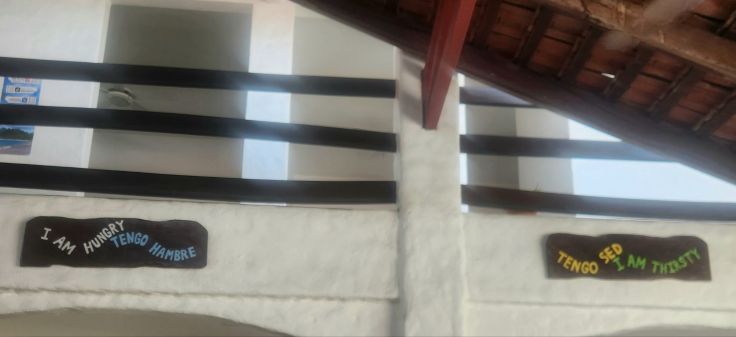
Having to learn sentence structure, vocabulary, and grammer for a second language forces me to reevaluate how, and why, I say what I do. Currently, with the Spanish vocabulary and grammar of a toddler, I must break down what I want to say into the most basic words and phrases. Which words in English, that I want to say in Spanish, are really needed to get the point across? It didn’t take long to realize how necessary a good vocabulary and a decent command of sentence structure are to conveying nuances and intent. Sure, I know the words required to get a glass of water, but am I saying it as a demand or a polite request? Have I conferred the appropriate respectfulness to the person I am asking? Imagine some stranger rudely, though inadvertantly, demanding something from one of your elderly, respected family members 😮 Forget correct tense (past, present, future) at this point in my learning, am I even using the right noun and verb? These questions facilitate a reevaluation of how I convey thoughts, complete with nuances and intent, even when speaking English. This results in more purposeful, effective communication in any language.
Broaden Worldview

At this point in my life, I’ve visited over twenty countries, which is miniscule in the face of a world of 195 of them. That relatively small background however, has given me a little insight into how cultures differ and are alike. Living with a host family has provided so much insight into everyday life in a different culture! It’s human nature to compare clothes styles, personal and municipality cleanliness, regional cuisine, living and moral standards, family relationships, rule of law, etc., through the lens of our native culture. I am learning that real personal growth/evolution comes from taking off my Western/American filters (at least, trying to) in order to see these things as stand-alone facts, and not things to be compared to what I am used to. The shared values and expectations that guide behavior within a specific cultural group provide a sense of identity and belonging. Factors that influence these cultural norms are complex, and involve social, historical, and environmental components. As I learned recently during the National Costa Rican holiday of Juan Santamaria Day, American influence has affected culture around the world, both positively and negetaively. If you would like to read more about the holiday, and America’s role in the events surrounding it, click HERE. I don’t remember ever being taught about America’s role in Central or South America, nor had I thought to look into it. Which leads me to . . .
Learn History
I’ve been a voracious reader my whole life. The last decade or so, I’ve expanded my reading repitoire to include more history. With the internet at my fingertips, I felt confident enough in my search ability that I thought I was reading a well-rounded portrayal of historical events. During my moto circumnavigation of the U.S. a few years ago, though, where I visited nearly a hundred museums and National Park Service units, I discovered that I had only been getting select perspectives of historical events based on my insufficiently informed search critera. Sure, I can do an internet search, but if I don’t know, or choose not to use, the most appropriate keywords in the search, I miss so many pieces of the puzzle. I was mistaking the fragmented view I was getting from my shotgun approach to topics as the whole picture…and didn’t even know it! Basically, I didn’t know what I didn’t know. Oftentimes, there’s no single “right” source to go to on any given topic. I’ve learned that in order to open the aperture enough to see a bigger, more complete picture, I have to point my camera at a subject from multiple angles, and consider them all, in relation to each other. It is only from a multitide of perspectives, and an awareness of their interconnectedness, that I even have a remote chance of seeing the true whole. For me, the whole is so much more fascinating and enlightening, albeit sometimes more uncomfortable, than the single-sided story to which I had become accustomed.
Continue to Learn Humility and Improve Self-Esteem

It’s taken a decent amount of vulnerability to be a woman in my 50s, walking around and talking like a toddler! People here are patient for the most part, but it’s got to be hard for them to listen to an adult stumble around words like a little kid in an effort to make a coherent sentence when they have work and other time-sensitive things to do. I remember being unable to speak to my maternal great-grandparents as a kid because they didn’t know English and I didn’t know Cajun French. It’s easy to wonder why someone can’t just learn to speak the dominant language when everyone around them can, and does. But once it’s YOU struggling to learn a second language as an adult, you start to understand how difficult, embarrassing, and frustrating it can be. I am continually humbled, and inspired, by the intelligence and tenacity of bilingual people, especially those who learned a non-native language as an adult. It’s such a boost to confidence, and self-esteem, when someone understands what I am trying to say or when I understand what someone else is saying! Hopefully, this serves as a catalyst for those of you with children to ensure they have exposure to, and are taught, a second language while they are young if it is at all possible. It will serve them well in adulthood and make it easier for them to pick up other languages later.
Become a Better Citizen and Ambassador
I recently read a book entitled “Frenchies.” It’s the story of how a generation of Cajuns, who were punished and ridiculed for speaking their native Cajun French language anywhere outside the home, became indispensible during World War II. Though forbidden to speak it at school, the Cajun French spoken as the primary language at home in Louisiana ended up being the same dialect of the French resistence during the war. This allowed the Cajuns to integrate seemlessly into the French population, without German detection, to collect intel and translate for Allied forces. Another example of the criticality of bilingual citizenry are the Native American Windtalkers, also of World War II. If the endless amount of money and training poured into teaching adults a second language is any indication, the U.S. will always have need for bilingual people, in both everyday commerce and during times of crises. Even though I am no longer in the military, I would like to still be an asset, and not a liability, to our nation and its citizens, in ways that I am still able. In the past, I have represented the U.S. on foreign soil as both a member of the Armed Services and a delegate to Olympic Games. Those experiences have made me sensitive to the fact that, like it or not, I am the face of America anytime I interact with people outside our borders. I think that even a rudimentary attempt at speaking the language of the country in which I find myself goes a long way towards goodwill between nations.
Although this post doesn’t have cool action photos, I hope it was still worth your attention and that it provided you with some insight into why I have undertaken this journey. At the end of the day, I’m still a joyful collector of experiences, and this jaunt has become a prized experience in my collection.
 FitHippie Adventures
One of your very best posts. You are still one of my heroes.
Chief
LikeLiked by 1 person
Thank you Chief! This has been such a humbling and rewarding experience 😊
LikeLike